SHOULDER INJURY AFTER A COLLISION OR A FALL
Almost nobody is relaxed at the moment of impact. The arm goes out, the hand locks onto something, and the shoulder takes a load through a straight arm that it is not built to take. A fall onto the point of the shoulder does something different again. Both end in the same conversation about whether the tear was already there — and that conversation is asking the wrong question.
Start with the number the whole thing turns on
In the Chingford cohort — 1,003 women aged 64 to 87, scanned as a general population sample rather than as a clinic sample — full-thickness rotator cuff tears were present in 22.2%, and 48.4% of those full-thickness tears were asymptomatic.
Half of them hurt nobody. So the presence of a tear on a scan does not establish that the tear is what hurts, in you, now. What changed on the day was not necessarily the anatomy. It was the shoulder's capacity to tolerate the anatomy it already had.
Margin is the right word, and margin is biological
A shoulder that compensated silently for years was running on a reserve: cuff strength, scapular control, a cervical spine contributing quietly, and a tendon repairing microdamage at roughly the rate it was accumulating. The event spent the reserve. Restoring function means rebuilding it, and part of what determines whether it can be rebuilt has nothing to do with the shoulder.
A systematic review and meta-analysis of risk factors for rotator cuff tendinopathy found systemic and metabolic associations, not only mechanical load. That is the unglamorous half of shoulder care and it is the half that decides who does well. A cuff being asked to repair itself in a body with untreated insulin resistance, poor sleep and continued nicotine exposure is being asked to work against its own supply chain, and no injection outruns that. Why a pain clinic asks to see your bloodwork covers what we measure and why we measure it before, not after.
Then work out which structure is actually generating the pain
About half of what arrives as shoulder pain is not coming from the shoulder, which is the subject of the shoulder-or-neck page. Referred pain from the cervical spine reproduces a shoulder pattern convincingly enough that treating the largest finding on the report is a coin flip. Examination first, target second, catalyst last.
What we decide before anything is offered
Whether the cuff is the pain generator at all, and if it is, whether the problem is a structural failure that needs a surgeon or a stalled repair in a tendon that is still continuous. Those are different problems with different answers, and no injection resolves the first one. Which modality suits a confirmed cuff target, and who it does and does not suit, is worked through on the rotator cuff page.
What we will not do is treat the largest finding on a report because it is the largest finding on a report. Half of these tears are silent; the one on your scan has to earn the attribution before it earns a needle.
If a needle goes into a shoulder here, it goes in under ultrasound
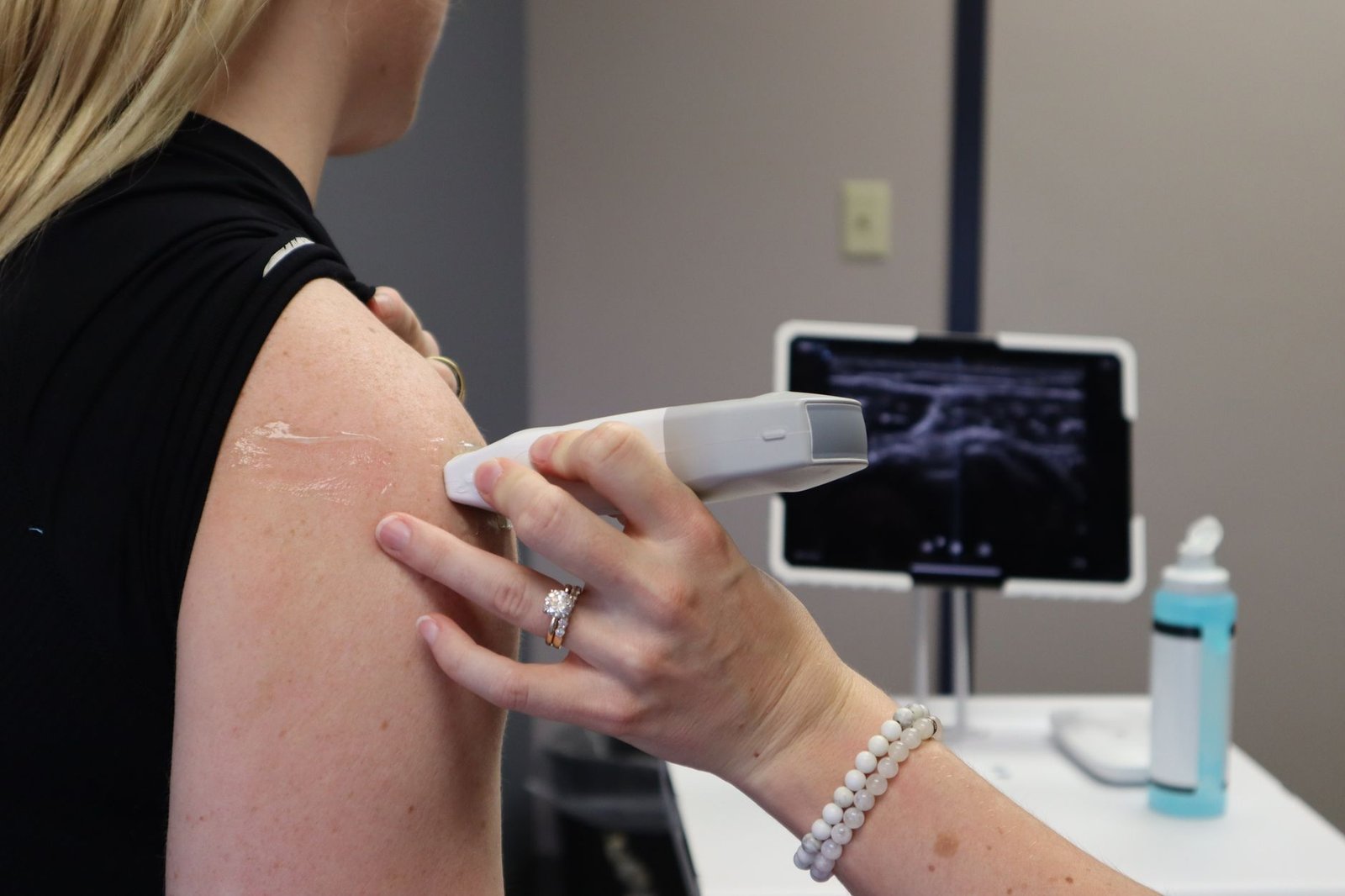
A systematic review and meta-analysis found ultrasound-guided shoulder girdle injections both more accurate and more effective than landmark-guided injections. The shoulder girdle is a cluster of small targets sitting close together, and a catalyst delivered by feel into the wrong one is not a treatment that failed. It is a treatment that never happened. The record should say which structure was entered and how placement was confirmed, and ours does.
The order we work in
Terrain measured and, where it can be, corrected. Scapular mechanics and posterior cuff loading. A real answer on whether the neck is contributing. Then a decision about the target, and only then a guided injection with a characterized preparation. The order is the treatment. The injection is one step inside it.
Questions after a shoulder injury
They say my rotator cuff tear is degenerative and pre-existing. Is that right?
It may be anatomically right and still be the wrong conclusion, because 48.4% of full-thickness tears in a general population cohort were asymptomatic. A tear that existed painlessly is not the same as a shoulder that was fine, and the difference is capacity rather than anatomy — which is what the rotator cuff page works through.
Will an injection fix my torn rotator cuff?
A tear that has lost continuity is a structural problem and no injection restores it, so the first question is always which of those two situations you are in. What a biologic is aimed at in a cuff that is still continuous, and who it suits, is on the rotator cuff page.
My shoulder hurts but the imaging is of my neck. Which is it?
Often both, and the proportion coming from each is worth establishing before anyone treats either, because referred cervical pain reproduces a shoulder pattern convincingly. That is why this is its own page.
Does it matter whether the injection is done with ultrasound?
At the shoulder girdle it matters measurably: guided injections are more accurate and more effective than landmark-guided ones in the pooled data. Why placement and preparation are both recorded here is on the what-to-expect page.
Why are we discussing my A1C when I injured my shoulder in a crash?
Because the risk-factor evidence for cuff tendinopathy is systemic as well as mechanical, and a repair signal delivered into a body that cannot execute it is spent for nothing. What gets measured, and why it comes first, is on the metabolic health page.
On the shoulder, and around it
- PRP and the rotator cuff
- Shoulder or neck?
- Terrain first, then the catalyst
- When the scan is normal and the injury is not
- Why we ask for bloodwork
- What an appointment involves
Find out which structure in your shoulder is actually the problem
A shoulder with a finding on a scan and a shoulder with a diagnosis are two different starting points. We work out which one you have, and what it is repairing in.
12174 Natural Bridge Rd, Suite 303
St. Louis, MO 63044
Next to DePaul Hospital, just off the 270 and 70 junction, west of the airport.
Sources
- Hinsley H, Ganderton C, Arden NK, Carr AJ. Prevalence of rotator cuff tendon tears and symptoms in a Chingford general population cohort, and the resultant impact on UK health services. BMJ Open, 2022. PubMed 36100305 doi:10.1136/bmjopen-2021-059175
- Leong HT, Fu SC, He X, et al. Risk factors for rotator cuff tendinopathy: a systematic review and meta-analysis. J Rehabil Med, 2019. PubMed 31489438 doi:10.2340/16501977-2598
- Aly AR, Rajasekaran S, Ashworth N. Ultrasound-guided shoulder girdle injections are more accurate and more effective than landmark-guided injections: a systematic review and meta-analysis. Br J Sports Med, 2015. PubMed 25403682 doi:10.1136/bjsports-2014-093573
- Laver L, Filardo G, Sanchez M, et al. The use of injectable orthobiologics for knee osteoarthritis: a European ESSKA-ORBIT consensus. Part 1 — blood-derived products (platelet-rich plasma). Knee Surg Sports Traumatol Arthrosc, 2024. PubMed 38436492 doi:10.1002/ksa.12077
- D'Souza RS, Her YF, Hussain N, et al. Evidence-based clinical practice guidelines on regenerative medicine treatment for chronic pain: a consensus report from a multispecialty working group. J Pain Res, 2024. PubMed 39282657 doi:10.2147/JPR.S480559
- Hoeber S, Aly AR, Ashworth N, Rajasekaran S. Ultrasound-guided hip joint injections are more accurate than landmark-guided injections: a systematic review and meta-analysis. Br J Sports Med, 2016. PubMed 26062955 doi:10.1136/bjsports-2014-094570