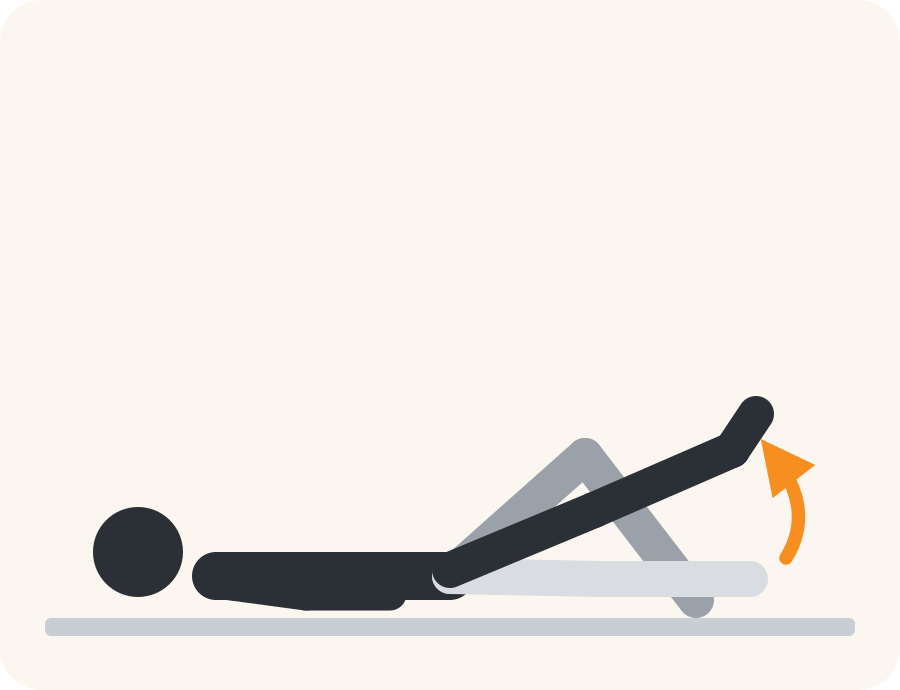
The straight leg raise is a home exercise we teach for knee pain, both while a knee is being prepared for PRP and while it recovers afterward. Lie flat on your back. Bend the knee of your good leg and set that foot on the floor. Tighten your thigh to lock the sore knee straight, then raise the leg to the height of your bent knee. Let it down slowly. Pause 2 seconds at the top. Repeat 10 times.
Your physician marks which exercises are yours on your home sheet. If this one is marked, do it twice a day unless your sheet says something else.
How do you do the straight leg raise?
- Get set: Lie flat on your back. Bend the knee of your good leg and set that foot on the floor.
- Move: Tighten your thigh to lock the sore knee straight, then raise the leg to the height of your bent knee. Let it down slowly.
- Dose: Pause 2 seconds at the top. Repeat 10 times.
Why does the straight leg raise matter before and after PRP?
The leg stays straight, so the knee joint does not bend under load. That lets you build thigh and hip strength even while the joint is irritable.
Because the joint stays still, this is a safe way to keep strength up in the weeks around an injection. Your physician tells you when to start it after a procedure.
Which mistakes should you watch for?
- Allowing the knee to bend while the leg rises. Tighten the thigh first, then lift.
- Swinging the leg up fast or raising it higher than the other knee.
- Arching your lower back off the floor.
When should you stop and call us?
Mild stretching, a little discomfort or some soreness the next morning is expected. Stop the exercise and call (314) 886-5092 if you notice:
- Pain that is sharp or stabbing
- Pain at least 2 points above your usual number that is still there an hour later
- Numbness, tingling or weakness that is new
- Dizziness or a change in your vision
- New swelling, heat or redness at an injection site
Call 911 for chest pain, trouble breathing or fainting.
Keep a log
Mark the log whenever you finish a session, and write down one pain score per day. Bring the log to each visit. Your technician counts how many days you did them and has you show one move so we can check your form.
What to remember
- Tighten the thigh before you lift.
- Raise only to the height of the bent knee.
- Lower slowly; no dropping.
Show us you have it: At your visit, do one lift for us and say how high the leg should rise. Anything still unclear? Ask, and we will go over it with you again.
Other knee exercises
Keep reading: PRP for knee arthritis, meniscus tears.
This exercise belongs to our physiotherapy program for PRP and joint care, in which a physician orders and oversees every part of your care.
Not sure this exercise is right for you?
Your physician decides which exercises fit your knee and when to start them around an injection. Book an evaluation or get the free guide.
12174 Natural Bridge Rd, Suite 303
St. Louis, MO 63044