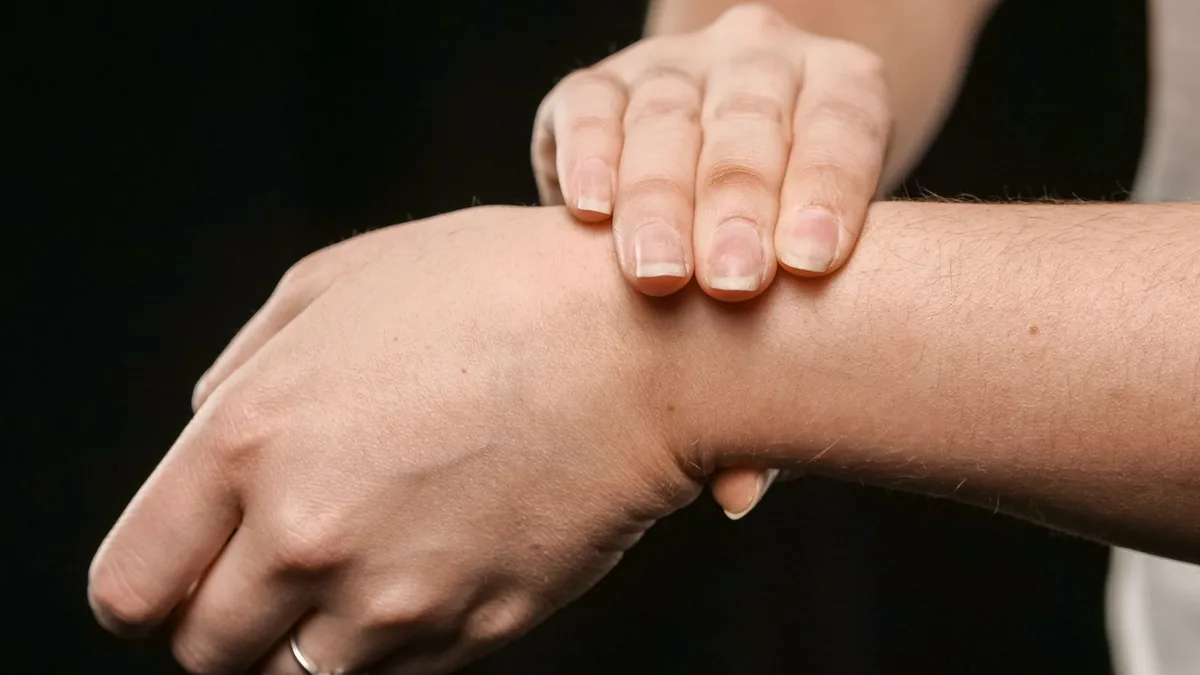
PRP for neuropathy works best when the pain comes from one nerve that is pinched or inflamed at a tight spot, like the wrist, the inner ankle or the outside of the knee. We find that spot by exam and ultrasound, then place PRP around the nerve under ultrasound guidance to calm the inflammation that keeps it firing.
Most people who search for this have been told they have neuropathy and handed a pill. Some of them do have a nerve disease that runs the length of both legs. Many have something narrower: a single nerve squeezed where it passes through a tunnel or crosses a bone, sending burning and tingling down everything it supplies. That second kind is the one this page is about, because it has an address, and an address can be treated.
Could my neuropathy be one pinched nerve?
Often, yes. Nerves travel through narrow places, and the narrow places are where they get into trouble. These are the ones we treat most:
- The median nerve at the wrist (carpal tunnel). Numb, tingling thumb and first fingers, worse at night and when you grip a steering wheel or a phone.
- The tibial nerve behind the inner ankle (tarsal tunnel). Burning in the sole of the foot that builds the longer you stand.
- The peroneal nerve at the outside of the knee, where it wraps around the top of the fibula, just under the skin. Tingling down the outer shin and the top of the foot, sometimes after weight loss, a cast, or a habit of sitting with your legs crossed.
- The small skin nerves, such as the superficial peroneal nerve on the front of the ankle and the saphenous nerve along the inside of the knee and shin. Tight boots, an old sprain or a scar can pin them.
The trouble is that a pinched nerve rarely announces itself as a nerve. It gets filed as a joint or a disc. In a study of 834 people with low back pain, 14% had an irritated superior cluneal nerve, a small nerve crossing the rim of the pelvis, and almost half of them had leg symptoms that invited a spine diagnosis. A thigh nerve trapped at the hip (meralgia paresthetica) shows up alongside carpal tunnel at more than seven times the expected rate, which tells you some bodies are simply prone to squeezing their nerves.
I have watched good physicians treat a nerve as a joint, and I have done it myself. Picture a woman in her late fifties, two years after a knee replacement that looks perfect on X-ray. The burning along the inside of her shin is worse than her arthritis ever was, and her chart says “failed knee.” Two inches below the joint line, where a branch of the saphenous nerve crosses her scar, one fingertip of pressure lifts her off the table. The knee has not failed. A nerve has become the pain generator, and for two years it has been treated in a language it does not speak.
How do you find the irritated spot on a nerve?
With hands first and a machine second. The exam takes about ninety seconds, and it is the step most often skipped.
- We map the pain. A pinched nerve hurts in its own territory, not in a vague cloud. The map tells us which nerve to follow.
- We test the skin. Light touch, pinprick and temperature. Numbness, or pain from a touch that should not hurt, is the sign that matters most.
- We press along the nerve. At the trouble spot, pressure reproduces your exact pain or sends tingling down the limb.
- We look with ultrasound. An irritated nerve is often swollen just before the tight spot. Ultrasound shows that swelling, the tissue pressing on the nerve, and the vessels to stay clear of.
- We numb it, when the answer is not clear. A small amount of local anesthetic placed at that one spot should take your pain away for a few hours. If it does, we have found the sender.
That last step rests on a striking finding. In 14 people with painful nerve damage in the feet, numbing the nerve below the knee abolished their pain completely in every one of them, within a median of ten minutes, at blood levels too low to act on the brain. The pain was being made out at the nerve, not in the head. When the exam shows weakness in the muscles a nerve supplies, or when two problems overlap, we add a nerve test of the arm or a nerve test of the leg.
Where do PRP injections for neuropathy go?
Around the nerve, never into it. This is called a perineural injection. We draw a small amount of your blood, spin it to concentrate the platelets, and with the ultrasound probe on the skin we guide a thin needle to the tissue that wraps the nerve at the spot we found. You watch the needle on the screen with us. The PRP spreads in a sleeve along the nerve, and the fluid itself gently lifts the nerve off the tissue it has been stuck to.
Because we treat the address and not the label, the target changes from person to person: the carpal tunnel at the wrist, the tibial nerve behind the inner ankle, the peroneal nerve below the outside of the knee, or the skin nerve that the exam points to. How PRP itself is prepared is on what PRP is.
What does PRP do around an irritated nerve?
It works on the noise. A nerve that has been squeezed for months sits in inflamed, swollen tissue, and that tissue keeps poking its pain fibers. The fibers that carry burning pain are called C-fibers, and once irritated they start firing on their own, with nothing touching them. When researchers recorded single fibers in people with nerve disease, 40.5% of the C-fibers were firing spontaneously in those with pain, against 14.6% in those without it. The burning you feel at rest is that firing.
PRP placed around the nerve delivers a concentrated dose of the signals platelets carry, the ones that turn inflammation down and settle the tissue back toward a working state. Calm the tissue and the C-fibers have less to react to. They quiet.
Then comes the part most people never hear about. Every pain fiber reports to a cluster of nerve cell bodies just outside the spine, the dorsal root ganglion, or DRG. After months of nonstop traffic, the DRG learns to fire on its own too. In 31 amputees with phantom limb pain, anesthetic applied to the DRG switched the phantom pain off, which showed the DRG itself was generating it. The goal of treating the periphery is to cut the traffic long enough for the DRG to reset how loudly it fires. Quiet input, quieter relay station, quieter brain.
Does PRP work for carpal tunnel and diabetic feet?
Carpal tunnel has the most trials, so the wrist is where the evidence is clearest.
- In 50 people with mild to moderate carpal tunnel in Greece, one ultrasound-guided PRP injection succeeded in 76.9%, against 33.3% with a saltwater injection, at 12 weeks.
- In 98 people in Egypt, PRP and a steroid injection both helped, and by three months PRP was ahead on pain and hand function.
- In 26 people in Taiwan with moderate to severe carpal tunnel in both hands, one wrist got PRP and the other got saltwater. The PRP wrist had milder symptoms at every check, out to one year.
- Pooling 18 trials of injections for carpal tunnel, PRP relieved symptoms and pain in the short and long term, while steroids helped only in the short term.
For the feet, the key trial enrolled 60 adults in Egypt with type 2 diabetes and nerve pain in the feet for at least six months. Half received ultrasound-guided perineural PRP plus their usual medicines; half received the medicines alone. The PRP group had less pain and less numbness at one, three and six months, and their neuropathy symptom scores improved.
Here is who those trials studied, so you can judge how far they reach. They were small and each ran at a single center. The diabetic trial compared PRP with medicines alone rather than with a sham injection. Most carpal tunnel trials took mild to moderate cases. That is why we treat a confirmed trouble spot, and why the exam above comes before anything is injected.
Why do diabetic feet burn, and what has to change besides the injection?
Because blood sugar does chemistry on the nerve. In people with diabetes and painful feet, 72% of the recorded pain fibers were firing on their own, against 15% in people with diabetes whose feet did not hurt. In diabetic mice, that firing tracked methylglyoxal, a toxic byproduct of excess sugar that irritates a channel on the pain fiber. A nerve soaking in it is primed to fire, and a nerve that is also squeezed at the ankle has two reasons to burn.
So an injection alone is half a plan. We check the bloodwork that tells us how much of that chemistry is running, and work on it with you, which is laid out on metabolic health. The other half is the daily load on the nerve. A keyboard job or a warehouse scanner bends the wrist for eight hours. Steel-toe boots press the top of the foot. Sitting cross-legged leans on the peroneal nerve. Nobody built those jobs around your nerves, and the rent still gets paid. We work with what you actually do all day: a wrist brace that keeps the wrist straight at night, a change in lacing or footwear, a different way to sit. Each one takes pressure off the tunnel the PRP is working in.
What happens at the visit, and over the weeks after?
The first visit is the hunt: history, the exam, ultrasound, and a numbing test if it is needed. When the spot is confirmed, your blood is drawn and prepared at the same visit as the injection. You are awake and you drive yourself home. The day itself is described in what to expect, and the soreness afterward in where PRP hurts most.
Change comes over weeks, not hours. The trials measured at one, three and six months, and that is roughly the calendar we use. Night symptoms often ease first, then the burning at rest, then numbness. We see you again to examine the nerve and decide on the next step. Whether a second injection makes sense is a clinical decision made at that visit, never a package booked in advance, as explained on how many PRP injections.
Most entrapped nerves we see cause pain and tingling without lasting weakness, and those are the ones we treat this way. When a nerve test shows the muscle it supplies is losing strength, decompression comes into the plan, and we tell you that at the visit.
Questions about PRP around a nerve
Is PRP for neuropathy the same as a nerve block?
No. A block is a numbing medicine that answers a question: is this the spot? It wears off in hours. PRP is the treatment placed at the spot the block confirmed, and it works over weeks. We explain how we judge the evidence for each on why trials disagree.
Does the needle touch the nerve?
It stays beside it. Ultrasound shows the nerve, the needle and the nearby vessels the whole time, so the PRP lands in the tissue around the nerve and not inside it. The side effects that do occur are listed on PRP risks.
Do I stop my nerve pain medicine after PRP?
Not on the day. In the diabetic foot trial, PRP was added to the medicines people already took. As the burning settles we lower doses with you, one step at a time, the same way we approach every pain medicine on opioid stewardship.
My heel burns. Is that plantar fasciitis or a nerve?
It can be either. Sharp pain on the first steps out of bed points to the fascia; burning that builds through the day points to a nerve near the heel or the tarsal tunnel. The exam tells them apart, and the fascia side is covered on PRP for plantar fasciitis.
Sources
- Kuniya H, Aota Y, Kawai T, et al. Prospective study of superior cluneal nerve disorder as a potential cause of low back pain and leg symptoms. Journal of Orthopaedic Surgery and Research, 2014;9:139. doi.org/10.1186/s13018-014-0139-7
- van Slobbe AM, Bohnen AM, Bernsen RMD, Koes BW, Bierma-Zeinstra SMA. Incidence rates and determinants in meralgia paresthetica in general practice. Journal of Neurology, 2004;251(3):294-297. doi.org/10.1007/s00415-004-0310-x
- Haroutounian S, Nikolajsen L, Bendtsen TF, et al. Primary afferent input critical for maintaining spontaneous pain in peripheral neuropathy. Pain, 2014;155(7):1272-1279. doi.org/10.1016/j.pain.2014.03.022
- Kleggetveit IP, Namer B, Schmidt R, et al. High spontaneous activity of C-nociceptors in painful polyneuropathy. Pain, 2012;153(10):2040-2047. doi.org/10.1016/j.pain.2012.05.017
- Vaso A, Adahan HM, Gjika A, et al. Peripheral nervous system origin of phantom limb pain. Pain, 2014;155(7):1384-1391. doi.org/10.1016/j.pain.2014.04.018
- Malahias MA, Nikolaou VS, Johnson EO, et al. Platelet-rich plasma ultrasound-guided injection in the treatment of carpal tunnel syndrome: A placebo-controlled clinical study. Journal of Tissue Engineering and Regenerative Medicine, 2018;12(3):e1480-e1488. doi.org/10.1002/term.2566
- Senna MK, Shaat RM, Ali AAA. Platelet-rich plasma in treatment of patients with idiopathic carpal tunnel syndrome. Clinical Rheumatology, 2019;38(12):3643-3654. doi.org/10.1007/s10067-019-04719-7
- Chen SR, Shen YP, Ho TY, et al. One-year efficacy of platelet-rich plasma for moderate-to-severe carpal tunnel syndrome: a prospective, randomized, double-blind, controlled trial. Archives of Physical Medicine and Rehabilitation, 2021;102(5):951-958. doi.org/10.1016/j.apmr.2020.12.025
- Yang FA, Wang HY, Kuo TY, et al. Injection therapy for carpal tunnel syndrome: A systematic review and network meta-analysis of randomized controlled trials. PLoS One, 2024;19(5):e0303537. doi.org/10.1371/journal.pone.0303537
- Hassanien M, Elawamy A, Kamel EZ, et al. Perineural platelet-rich plasma for diabetic neuropathic pain, could it make a difference? Pain Medicine, 2020;21(4):757-765. doi.org/10.1093/pm/pnz140
- Becker AK, Babes A, Düll MM, et al. Spontaneous activity of specific C-nociceptor subtypes from diabetic patients and mice: Involvement of reactive dicarbonyl compounds and (sensitized) transient receptor potential channel A1. Journal of the Peripheral Nervous System, 2023;28(2):202-225. doi.org/10.1111/jns.12546